clinical AI
Primary Care AI
Lotus Health AI
HIPAA Compliance
Most AI health apps give you a chatbot. The best ones bring a licensed clinician into every clinical decision — so any diagnosis, prescription, or care plan is reviewed by a real doctor before it reaches you.
Why clinician-in-the-loop AI matters now
Clinician-in-the-loop AI means a licensed physician or nurse practitioner reviews AI-generated clinical outputs before they reach the patient. This is the key difference between a clinical platform and a general-purpose chatbot.
Millions of people already turn[1] to tools like ChatGPT for health questions[2]. Those tools were never designed for clinical care. They have no access to your health records, no licensed clinician reviewing their outputs, and no accountability for clinical decisions. A chatbot will deflect when you ask who reviews your information. A clinical platform will give you a clear, verifiable answer.
Clinician oversight appears to add a meaningful safety layer over standalone AI — but it is worth being honest: high-quality clinical trials directly comparing these two models are still limited. What is clear is that AI alone carries real miss risks, especially for atypical or serious presentations. Adding a licensed clinician to the loop is the most responsible model available today.
AI alone gives you information. A clinician in the loop gives you care — with accountability.
How clinician-in-the-loop AI works step by step
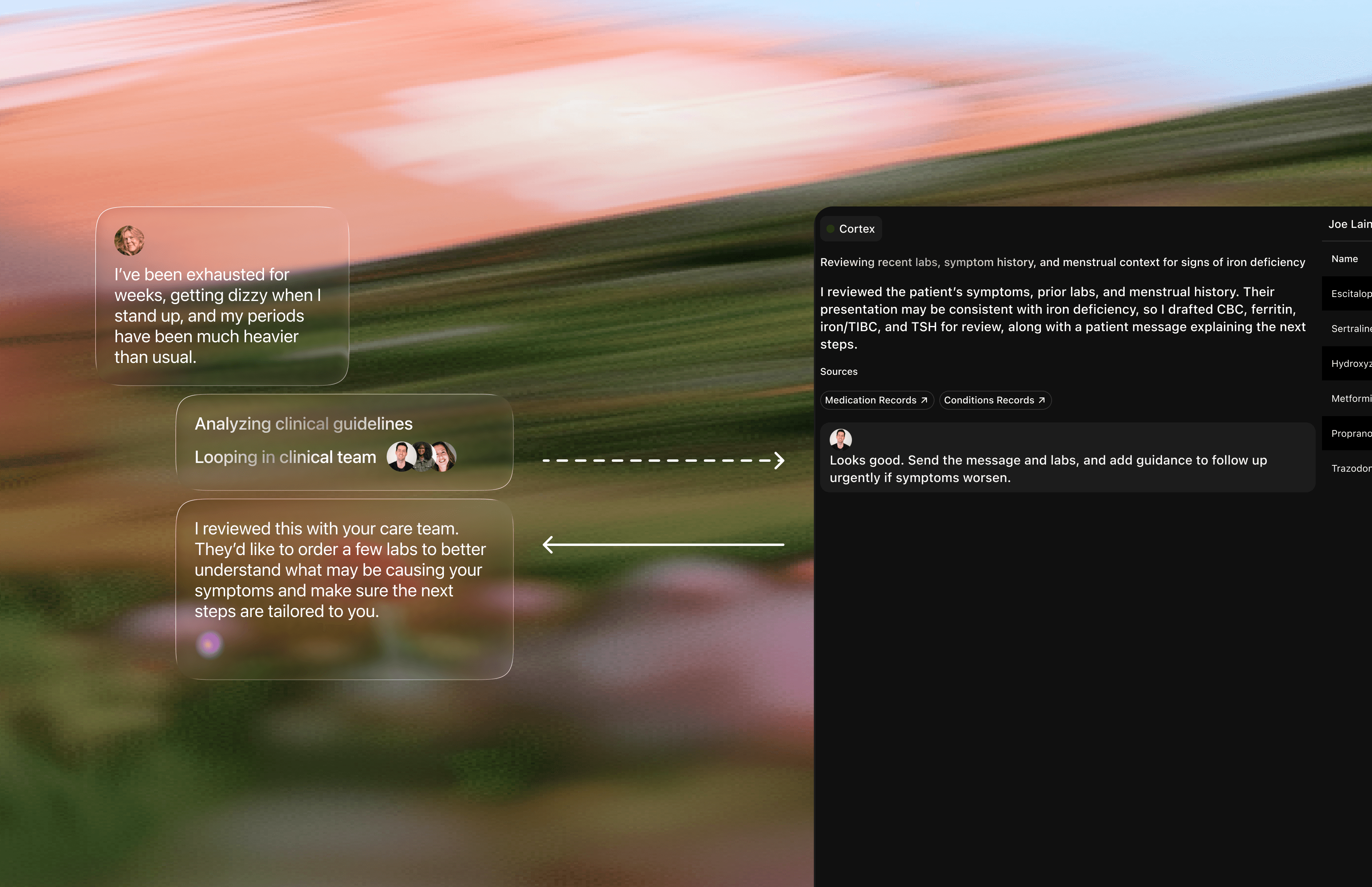
The workflow in a clinical AI app is not a single chat exchange. It is a structured sequence that moves from your first message to a reviewed care plan. Here is how that process works, using Lotus AI as the example.
Step 1 — Symptom intake and instant triage
You share a concern, and the AI checks for red flags while pulling in relevant context — labs, medications, health history — with your consent. It asks structured follow-up questions based on medical protocols to build a complete picture.
If red-flag symptoms appear at this stage, the app routes you to emergency care immediately. It does not continue chatting. Red flags include chest pain with sweating or arm and jaw radiation, sudden facial drooping or arm weakness (stroke signs), severe shortness of breath at rest, and new confusion or unresponsiveness.
Step 2 — Evidence matching and risk detection
The AI drafts a structured case summary by cross-referencing your symptoms and health records against peer-reviewed medical literature and major clinical guidelines. This step is automated — but it is explicitly a draft, not a final clinical decision.
Unified records matter here. When your labs, medications, wearable data, and prior visit history are all in one place, the summary reflects your whole picture — not a fragment from a single visit.
Step 3 — Licensed clinician review
A licensed clinician reviews the AI-generated summary alongside your data in one view. They can approve, adjust, or override the draft entirely.
AI itself never prescribes. A licensed clinician must review and sign every prescription, order, and clinical plan. Lotus AI's clinical team includes physicians from institutions such as UC Davis Health, UCSF[3], Stanford Medicine, and Harvard Medical School[4].
Step 4 — Orders, prescriptions, and referrals
After clinician review, the platform can issue prescriptions when clinically appropriate, order labs and imaging referrals, or refer you to the right specialist. For example, a clinician might prescribe an SSRI for anxiety, approve a statin refill for stable cholesterol management, order a thyroid panel, or initiate an imaging referral for a persistent joint issue.
Prescriptions are sent to your preferred pharmacy at no cost for the care itself. Note that Lotus AI does not cover the cost of the medications.
Step 5 — Follow-up and monitoring
The loop does not end at a single interaction. Lotus AI can conduct follow-up for stable conditions, track whether symptoms improve, and flag when escalation is needed.
For chronic conditions, this matters. Hypertension management benefits from home blood pressure monitoring as an ongoing check. Type 2 diabetes management includes periodic HbA1c tracking. Hypothyroidism requires TSH monitoring over time. When updated labs flow into your unified record, follow-up guidance reflects real data — not just your last conversation.
What AI doctor apps with clinician oversight can do today
Clinician-in-the-loop AI apps function as a primary care practice. They can diagnose, prescribe non-controlled medications, order labs and imaging, and manage stable chronic conditions — all reviewed by a licensed physician.
Diagnose and triage symptoms
An AI doctor can assess symptoms, ask clarifying questions, and provide a diagnosis grounded in clinical guidelines. Examples include evaluating a persistent cough, screening for depression or anxiety, assessing a skin rash from a photo, or triaging urinary symptoms.
When something exceeds primary care scope, the app refers you to the right specialist. Clinician review improves safety meaningfully compared to AI-only tools, which carry higher miss risks for atypical presentations.
Prescribe non-controlled medications
Many non-controlled medications are broadly appropriate for telehealth prescribing. These include:
Antibiotics for confirmed uncomplicated infections such as strep throat, sinusitis, or UTIs
SSRIs and SNRIs for depression or anxiety, with allergy and safety history reviewed
Antihypertensives when blood pressure is known and stable
Inhalers for asthma or COPD maintenance
Oral contraceptives, statins, thyroid medications, and topical treatments
Prescriptions are always a clinical decision — never guaranteed. A licensed clinician reviews and signs every one.
Order labs and imaging
Routine bloodwork and urinalysis can be ordered remotely when your history supports it. Common examples include HbA1c, lipid panels, CBC, TSH, urine culture, and STI panels. Imaging referrals for X-ray, CT, or MRI can also be initiated.
Results are pulled into your unified record when connected sources share them, and the clinician closes the loop with clear next steps.
Manage stable chronic conditions
Clinician-in-the-loop AI apps can handle ongoing management of stable conditions — refills, monitoring, and care coordination. Unified health records mean the clinician sees the full picture across conditions, not fragments from separate visits.
One important threshold: a blood pressure reading at or above 180/110 mmHg[5], or symptomatic hypoglycemia warrants same-day[6] clinician contact — not routine follow-up.
What AI doctor apps cannot do
No AI app replaces emergency care, physical exams, or controlled substance prescribing. Being clear about these limits is what separates a trustworthy clinical platform from one that overpromises.
No controlled substances
Controlled substances — opioids, benzodiazepines, and stimulants — are restricted in virtual care for overlapping safety reasons. Prescription opioids now drive more accidental deaths than cocaine and heroin combined[7]. Diversion and misuse cannot be reliably detected without in-person evaluation and urine drug screening. Dependence requires frequent reassessment that virtual-only care cannot consistently provide.
Lotus AI does not prescribe Adderall, Ritalin, Xanax, Klonopin, or opioids. Federal law requires an in-person visit for scheduled medications. That said, Lotus AI can still screen for the underlying condition — anxiety, ADHD symptoms, chronic pain — and refer you to the appropriate specialist who can prescribe in person.
No emergency care
Some symptoms require 911 or the ER, not an app. Call for emergency help immediately if you experience:
Chest pain or pressure with sweating, nausea, or arm and jaw radiation
Sudden facial drooping, arm weakness, or slurred speech
Severe shortness of breath at rest
High or very low temperature combined with confusion and rapid heart rate (possible sepsis)
A sudden worst-of-life headache with neck stiffness
Unresponsiveness or altered mental status
When in doubt, always go in person. No app substitutes for emergency care. Lotus AI can triage symptoms and route you to urgent care or the ER — but it is not the solution for emergencies. After an ER visit, it can help with follow-up, medication questions, and coordinating next steps.
No physical exams or procedures
Remote assessment has real structural limits. Without palpation, auscultation, or direct visualization, key exam findings that change management simply cannot be obtained.
If the diagnosis requires an exam finding to confirm or rule out a time-sensitive condition, the default should be in-person evaluation. Lotus AI can prepare you for that visit — your unified health records, symptom history, and prior lab results travel with you, so the doctor you see has the full picture from the start.
How Lotus AI compares to other AI health tools
There are three main categories of AI health tools[8]: generic chatbots, telemedicine funnels, and clinician-in-the-loop AI doctors. Understanding the difference helps you choose the right one.
Feature | Lotus AI | Generic AI chatbots | Telemedicine funnels |
|---|---|---|---|
Licensed clinician reviews every clinical decision | Yes | No | Yes, but only after booking a separate appointment |
Can diagnose and prescribe non-controlled medications | Yes, when appropriate | No | Yes, after a consult |
Can order labs and imaging | Yes | No | Varies |
Unified health records (labs, meds, wearables) | Yes | No | Rarely |
Available 24/7, no appointment needed | Yes | Yes | AI intake yes; clinician availability varies |
Guidance grounded in peer-reviewed evidence and guidelines[9] | Yes — PubMed, JAMA, NEJM, USPSTF[10], AHA/ACC[11], ADA[12], IDSA | Not reliably | Depends on clinician |
Cost to patient | Free | Free or subscription | Typically a per-visit fee |
Yes | Varies | Rarely |
Lotus AI vs. generic chatbots
Generic AI chatbots can explain medical terms and summarize information, but they cannot diagnose, prescribe, or order tests. They have no access to your health records and no clinician reviewing their outputs. Lotus AI is an AI doctor powered by real doctors — it functions as a primary care practice, not a search engine.
Lotus AI vs. telemedicine funnels
Traditional telehealth platforms use AI mainly as a receptionist — intake and scheduling — then require you to book and wait for a separate clinician appointment, often at a per-visit cost. Lotus AI integrates AI and clinician review into a single workflow, so you get an answer grounded in your unified health records without booking a separate call.
Cost and access
Lotus AI is free for patients — no hidden fees, no surprise bills, no data sales. It is available 24/7, in over 50 languages[14], with no insurance required. Lotus AI does not cover the cost of medications themselves, but the care — diagnosis, prescriptions when appropriate, referrals — costs nothing.
How to tell if an AI health app includes real clinician oversight
Not every app that uses the word "clinical" has a licensed clinician in the loop. Here is what to look for:
Licensed clinician review: A real physician or NP must sign any prescription or clinical plan. Automated text responses alone mean no clinical decision-making is happening.
State licensure disclosure: Legitimate platforms list the states where their clinicians are licensed to practice.
Escalation pathways: Clinical platforms clearly tell you when your concern needs in-person or emergency care — they do not just keep chatting.
Privacy and HIPAA compliance: Look for explicit data-use disclosures, encryption details, and a clear statement that data is never sold.
Evidence sourcing: Guidance should be grounded in named clinical guidelines and peer-reviewed sources, not generic AI-generated text.
Ask any platform directly: "Who reviews my information, and are they a licensed clinician?" A chatbot will deflect. A clinical platform will give you a clear, verifiable answer.
Lotus AI meets every criterion on this list. Licensed clinicians from top institutions review every clinical decision. Data is encrypted and never sold. Guidance is built on millions of peer-reviewed studies[15] and all major clinical guidelines.
Get safe, clinician-reviewed care — for free
Ask any health question, any time, in any language. Get a personalized care plan reviewed by a licensed physician. Prescriptions, lab orders, and specialist referrals when appropriate.
Try Lotus AI Free | Learn How It Works
Prescriptions and referrals issued when appropriate, reviewed by licensed physicians. Lotus AI is not a substitute for emergency care.
This article is for educational purposes only and does not provide medical advice. Always consult a licensed healthcare professional for diagnosis or treatment decisions. If you think you may be having a medical emergency, call 911 or your local emergency number immediately.
Sources
The era of Doctor AI is already here — Axios, 2026
Authority Signals in AI Cited Health Sources — arXiv, 2026
Lotus Health AI homepage — Lotus Health AI, 2026
Lotus Just Raised $41M — Lotus Health AI (news release), 2026
Hypertension Guideline — Kaiser Permanente Washington, 2024
Diabetic hypoglycemia — Diagnosis & treatment — Mayo Clinic, 2025
Prescription Drug Deaths Increase Dramatically — Scientific American, 2009
Exploring AI in Healthcare Systems: A Study of Medical Applications and a Proposal for a Smart Clinical Assistant — Electronics (MDPI), 2024
Lotus Health AI raccoglie 41 milioni di dollari — Data4Biz, 2026
USPSTF Recommendation Statement (PDF) — U.S. Preventive Services Task Force, 2021
AHA/ACC Guideline on the Primary Prevention of Cardiovascular Disease (PDF) — American Heart Association/American College of Cardiology, 2019
ADA Standards of Care / evidence-based guidance (PDF) — American Diabetes Association, 2025
Navigation, Advocacy, and Telehealth Drive a Big Week for Global Health Innovation Funding — StartUp Health, 2026
The Most Important Software Nobody’s Built Yet — Lotus Health AI blog, 2026
Trisha Figures Out How to Stop Thumping Noises in Her Ear — Lotus Health AI, 2025