clinical AI
Primary Care AI
Clinical Decision Support
Lotus Health AI
AI can help you understand your symptoms, surface possible diagnoses, and point you toward the right care — but how much you can trust it depends entirely on what kind of AI you're using and what's behind it.
What is an AI doctor
An AI doctor is a software tool that analyzes your symptoms, medical history, and sometimes images to suggest possible diagnoses and next steps. The term covers a wide range of tools — from general-purpose chatbots like ChatGPT (which OpenAI's own terms say should not be relied on for medical decisions) to purpose-built clinical platforms that function as a real primary care practice with licensed physicians overseeing every recommendation.
That distinction matters. A generic chatbot explains information. An AI doctor powered by real physicians can diagnose, prescribe when clinically appropriate, and refer — with clinician accountability behind every action. Knowing which kind you're using changes how much weight you should give its output.
Can AI diagnose symptoms accurately
The honest answer is: it depends. AI can identify many conditions with meaningful accuracy, especially when it has enough clinical context to work with. But accuracy varies sharply depending on the type of condition, the quality of information provided, and whether a licensed clinician is involved in reviewing the output.
Where AI performs well today
Research shows AI performs strongest in specific, well-defined tasks — particularly medical imaging and structured data analysis.
ECG and heart rhythm detection: AI algorithms for detecting atrial fibrillation from a single-lead ECG [1] have reached sensitivity and specificity ranges comparable to cardiologist-read results in controlled studies.
Dermatology image analysis: In experimental settings, AI models have matched expert dermatologists [2] for specific conditions, outperforming residents and general practitioners on narrow image-classification tasks.
Symptom analysis with full clinical context: When AI is given a patient's clinical history alongside their presenting symptoms [3], diagnostic accuracy improves substantially compared to symptom input alone. Without that context, accuracy drops sharply.
Pattern recognition at scale: AI can scan thousands of studies [4], compare symptom clusters, and surface rare but relevant patterns that a time-pressed clinician might overlook — which is why some patients have found AI helpful in identifying conditions that multiple doctors had missed.
Most of these strong results come from narrow, curated tasks — not open-ended general diagnosis. That caveat matters.
Where AI still falls short
The failure modes are well-documented and worth understanding before you rely on any AI tool for health guidance.
Hallucination: AI can generate confident but clinically incorrect statements. These errors may go undetected in patient-facing communication and influence downstream decisions.
Atypical presentations: Statistical pattern-matching works well for common, typical cases. It is fragile for rare or unusual presentations — the very cases where errors cause the most harm.
No physical exam: AI assesses text and images, not vital signs, breath sounds, or physical findings. Red-flag symptom combinations that require hands-on assessment can be under-weighted by an AI working from text alone.
Training data bias: AI models inherit statistical patterns from their training data, which can produce systematic gaps in accuracy across different populations.
Quantified real-world harm rates from AI misdiagnosis are not yet robustly established — this is an active research gap. What the evidence consistently shows is that clinician oversight is a prerequisite, not an optional add-on. This is why platforms like Lotus AI pair AI analysis with licensed physician review, so the AI's pattern recognition is checked by human clinical judgment before any diagnosis or prescription reaches you.
When a doctor should step in
AI is a powerful starting point. It is not the right tool for every situation. Knowing when to escalate — and how quickly — is the most important safety skill you can develop as someone using AI health tools.
Red-flag symptoms that need emergency care now
Do not use AI for these. Call 911 immediately.
Chest pain or pressure with sweating, arm or jaw radiation, or shortness of breath — possible heart attack
Stroke symptoms — sudden face drooping, arm weakness, speech difficulty, or vision loss
Anaphylaxis — throat tightening or hives with breathing difficulty
Sepsis signs — high fever or abnormally low temperature with confusion, rapid heart rate, or low blood pressure
Severe shortness of breath at rest, major uncontrolled bleeding, loss of consciousness, or suicidal intent with a plan — for mental health crises, call or text 988 (Suicide and Crisis Lifeline)
Lotus AI can help with initial triage and route you to the right level of care, but it is not a substitute for emergency services. After an emergency visit, it can help you understand discharge instructions, track follow-up care, and consolidate records from the ER with your broader health history.
Situations where AI-only guidance is not enough
Beyond emergencies, there are specific populations and scenarios where AI-only care is clinically inappropriate regardless of how good the tool is.
Pregnancy or infants under three months — physiology changes rapidly, and medication safety requires specialist oversight
Immunocompromised patients — infections can deteriorate silently without typical warning signs
Patients on anticoagulants — bleeding and clotting risks require lab monitoring that AI cannot perform
Rapidly worsening symptoms — any symptom significantly worse within hours warrants same-day or emergency evaluation
For high-risk complaints like severe headache, sudden dizziness, chest pain, or significant abdominal pain, clinical guidelines consistently require physical exam findings and objective data before management decisions can be made. History alone — whether gathered by AI or a human — is not enough. In these situations, Lotus AI serves as the starting point: assessing symptoms, recommending the right level of care, referring to the appropriate specialist, and preparing your unified health records so the in-person visit is more effective.
How to use an AI doctor safely
The difference between a helpful AI health experience and a harmful one usually comes down to how you use the tool — not just which tool you choose.
Steps to get reliable answers from AI
Provide full clinical context. Include your relevant medical history, current medications, allergies, and specific symptom details — when it started, how severe it is, what makes it better or worse. AI accuracy improves substantially with context and drops sharply without it.
Watch for hallucinations. If a response includes a drug name you've never heard of, a specific reference number, or a claim that sounds unfamiliar, verify it with a trusted source or your clinician before acting on it.
Use AI as a starting point. Treat AI output as a first step for gathering information and preparing questions — not as a final diagnosis.
Follow escalation guidance. If the tool recommends urgent care or an ER visit, act on it. Do not override safety recommendations because the answer feels inconvenient.
Choose a tool with clinical oversight. A platform where licensed physicians review recommendations is materially safer than a generic chatbot with no medical accountability.
How to protect your health data
Once medical information enters a generic chatbot, it may no longer be private. Some platforms have had chat transcripts indexed by search engines without user permission. Before using any AI health tool, check whether it has clear, published privacy protections — and avoid entering sensitive personal information into tools that don't.
Lotus AI encrypts your data, uses it only for your care, and never sells it. That is a meaningful difference from general-purpose AI tools where your health information becomes part of a broader data environment you cannot control.
How Lotus AI delivers doctor-supervised AI care
Most AI health tools make you choose between speed and safety. Lotus AI is built on the premise that you should not have to choose.
What powers Lotus AI
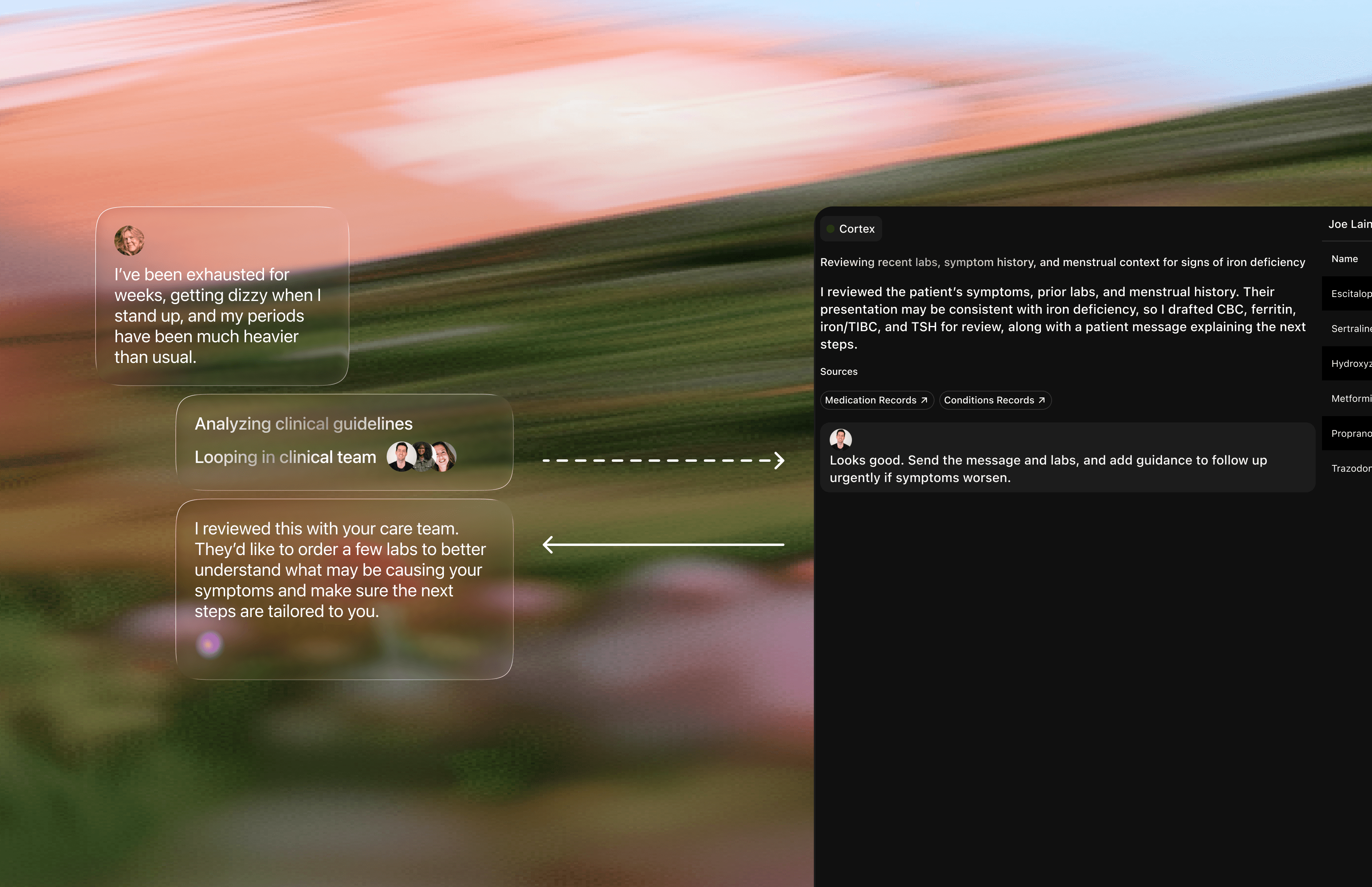
Lotus AI is a free primary care practice — an AI doctor powered by real physicians and the latest medical evidence. It is not a search engine or a chatbot. Licensed clinicians are accountable for clinical actions.
Evidence base: Guidance built on millions of peer-reviewed studies [5] and all major clinical guidelines, including PubMed, JAMA, NEJM, USPSTF, AHA/ACC, ADA, and IDSA
Physician oversight: Real clinicians from institutions including UC Davis Health, UCSF, Stanford Medicine, and Harvard Medical School [6] review and oversee care
Unified health records: Lotus AI automatically aggregates your medical records, wearable data, lab results, medications, and insurance information into one place — so guidance reflects your whole picture, not a single visit
Continuous improvement: The platform is continuously updated by clinical experts as new research emerges
What Lotus AI can and cannot do
Lotus AI can | Lotus AI cannot |
|---|---|
Answer any health question, 24/7, in 50+ languages | Prescribe controlled substances (Adderall, Xanax, opioids — DEA requires in-person visits) |
Diagnose conditions based on symptoms, history, and records | Perform physical exams, procedures, or specimen collection |
Prescribe non-controlled medications when clinically appropriate (antibiotics for strep or sinusitis, SSRIs for depression and anxiety, blood pressure medications, diabetes medications, oral contraceptives, most inhalers, dermatologic treatments) | Manage acute emergencies — it can triage and route, but is not a substitute for emergency care |
Order labs and imaging referrals | Guarantee a prescription will be issued — that is always a clinical decision |
Refer to the right specialist when something exceeds primary care scope | Cover the cost of medication |
Triage symptoms and route to urgent care or the ER when needed | Connect you with a live human doctor in real time |
Monitor stable chronic conditions with follow-up care |
Lotus AI is free because it removed waste, automated routine work, and unified data so doctors are more effective and the cost of care comes down. It is backed by over $41 million [7] from investors including Kleiner Perkins and CRV. No hidden fees, no surprise bills, no data sales.
Get answers you can trust — for free
Ask any health question, any time, in any language. Get personalized care plans reviewed by licensed physicians, with prescriptions, lab orders, and specialist referrals when appropriate.
Prescriptions and referrals issued when appropriate, reviewed by licensed physicians. Not a replacement for emergency care. This article is for educational purposes only and does not constitute medical advice, diagnosis, or treatment. Always consult a licensed healthcare professional for diagnosis or treatment decisions. If you think you may be having a medical emergency, call 911 immediately.
Sources
Accuracy of Artificial Intelligence–Based Technologies for the Diagnosis of Atrial Fibrillation: A Systematic Review and Meta‑Analysis — Journal of Clinical Medicine, 2023
Dermatologist‑level classification of skin cancer with deep neural networks — Nature, 2017
Importance of Patient History in Artificial Intelligence–Assisted Medical Diagnosis: Comparison Study — JMIR Formative Research, 2024
Artificial Intelligence Tools for Automating Evidence Synthesis: Scoping Review — Journal of the American Medical Informatics Association, 2025
MEDLINE — Wikipedia (U.S. National Library of Medicine summary), updated 2024
Why We Decided to Build Lotus—Now — Lotus Health AI, 2025
Lotus Health AI raises $41M to deliver free AI‑powered primary care direct to consumers — TBPN Digest, 2026