clinical AI
Lotus Health AI
Primary Care AI
Clinical Decision Support
Medical AI Research
ChatGPT can answer a lot of health questions — but answering well and answering safely are two different things, and the research shows a clear gap between what a general chatbot can do and what safe medical care actually requires.
Is ChatGPT better than a doctor
The honest answer is: it depends on the task, and the research shows clear limits on both sides. ChatGPT can match or outperform physicians on certain structured, benchmark-based tasks [1] — like answering standardized exam questions [2] or summarizing curated case vignettes [3] — but these are educational benchmarks, not real-world clinical encounters [4]. It consistently falls short in the areas that matter most for safe patient care: physical exam findings, ambiguous presentations, and real-time clinical judgment.
There is also a subtler risk. AI tends to sound confident even when it is uncertain. That is a safety problem, not a feature. A tool that gives you a wrong answer with full confidence is more dangerous than one that tells you it does not know.
The real question is not AI versus doctors. It is which kind of AI is built for healthcare — and which is not.
ChatGPT excels at sounding right. Purpose-built medical AI is designed to be right — and to tell you when it is not sure.
What studies show about AI vs. doctors
The research on AI and clinical performance is real, growing, and frequently misrepresented in headlines. Most studies test AI on curated, text-only cases — not the messy, real-time reality of clinical medicine. Here is what the evidence actually shows.
Diagnostic accuracy in emergency and hospital settings
Studies have tested ChatGPT and GPT-4 against emergency department physicians using retrospective written case data [5]. These studies used pre-written vignettes — not real emergency department workflow — and GPT-4 performed meaningfully below physicians on complex diagnostic cases in most comparisons. The design flaws in these studies systematically favor AI by removing the parts of medicine where humans excel:
No access to vitals, exam findings, or real-time labs — AI only saw text summaries prepared after the fact
Curated case selection — atypical or unusual cases can inflate or deflate apparent AI accuracy depending on how they are chosen
No dynamic follow-up — real medicine involves updating your thinking as new information arrives
Complex primary care and free-text cases
When AI is tested on complex, free-text primary care cases — the kind that require integrating social history, behavioral factors, and clinical nuance — physicians consistently outperform it. Clinicians reliably outperform LLMs (large language models, or AI systems trained on text) when cases require physical exam findings [6], procedural judgment, integrating evolving longitudinal data, or managing rare and atypical presentations.
LLMs are also prone to hallucination — generating plausible [7] but clinically unsupported statements with full confidence. That risk is especially serious when AI is generating management plans [8] rather than just explaining concepts.
Empathy and patient message quality
A widely cited study published in JAMA Internal Medicine found that ChatGPT responses were preferred over physician responses for quality and empathy when answering patient questions posted to a public forum. This finding is real — but the context matters. The physician responses in that study were brief, time-constrained forum replies, not representative of actual clinical consultations. Raters were not using a validated empathy instrument. Most importantly, these metrics reflect communication style, not clinical safety. No study to date has demonstrated AI superiority on outcomes [9] like missed diagnoses or patient harm.
ChatGPT writes better messages. Better messages are not the same as better medicine.
Why doctors plus AI did not always beat AI alone
One Stanford study found that doctors using ChatGPT performed only marginally better than doctors without it — while ChatGPT alone scored highest. Two reasons explain this: doctors treated ChatGPT like a search engine instead of pasting full case histories into it, and doctors did not change their diagnosis when AI disagreed with them. The problem was not AI capability — it was integration and training. Purpose-built medical AI is designed to solve exactly that, by fitting clinical workflows and keeping the human in the loop rather than making the tool an afterthought.
Where ChatGPT falls short for medical advice
ChatGPT was built to be a general-purpose conversational AI. It was not designed, trained, or regulated for clinical care. Its own terms of service say not to rely on it for medical decisions. The structural shortcomings are significant:
No access to your health history — In standard use, without health record integrations, ChatGPT has no access to your health history, labs, medications, or prior diagnoses
No physician oversight — no licensed clinician reviews or is accountable for what it tells you
Hallucination risk — it can generate plausible but clinically unsupported statements [10] with full confidence
No triage or escalation protocol — it cannot route you to urgent care, order labs, or refer you to a specialist
No prescribing capability — it cannot write prescriptions, order imaging, or take clinical action
No regulatory accountability — it is not a medical device and is not subject to clinical safety standards
ChatGPT can explain what a condition is. It cannot diagnose you, prescribe treatment, or take responsibility for what happens next. That distinction matters.
What makes purpose-built medical AI more reliable than ChatGPT
The difference between ChatGPT and a purpose-built medical AI is not just the underlying model — it is the design intent, clinical infrastructure, and accountability layer built around it. Here is what that looks like in practice.
Clinical guidelines and medical evidence
Purpose-built medical AI is trained on and constrained by peer-reviewed studies and major clinical guidelines — not general internet text. General chatbots optimize for broad benchmark performance. Clinical AI is evaluated on reliability and robustness in real patient care contexts. That distinction shapes every answer the system gives.
Physician oversight and accountability
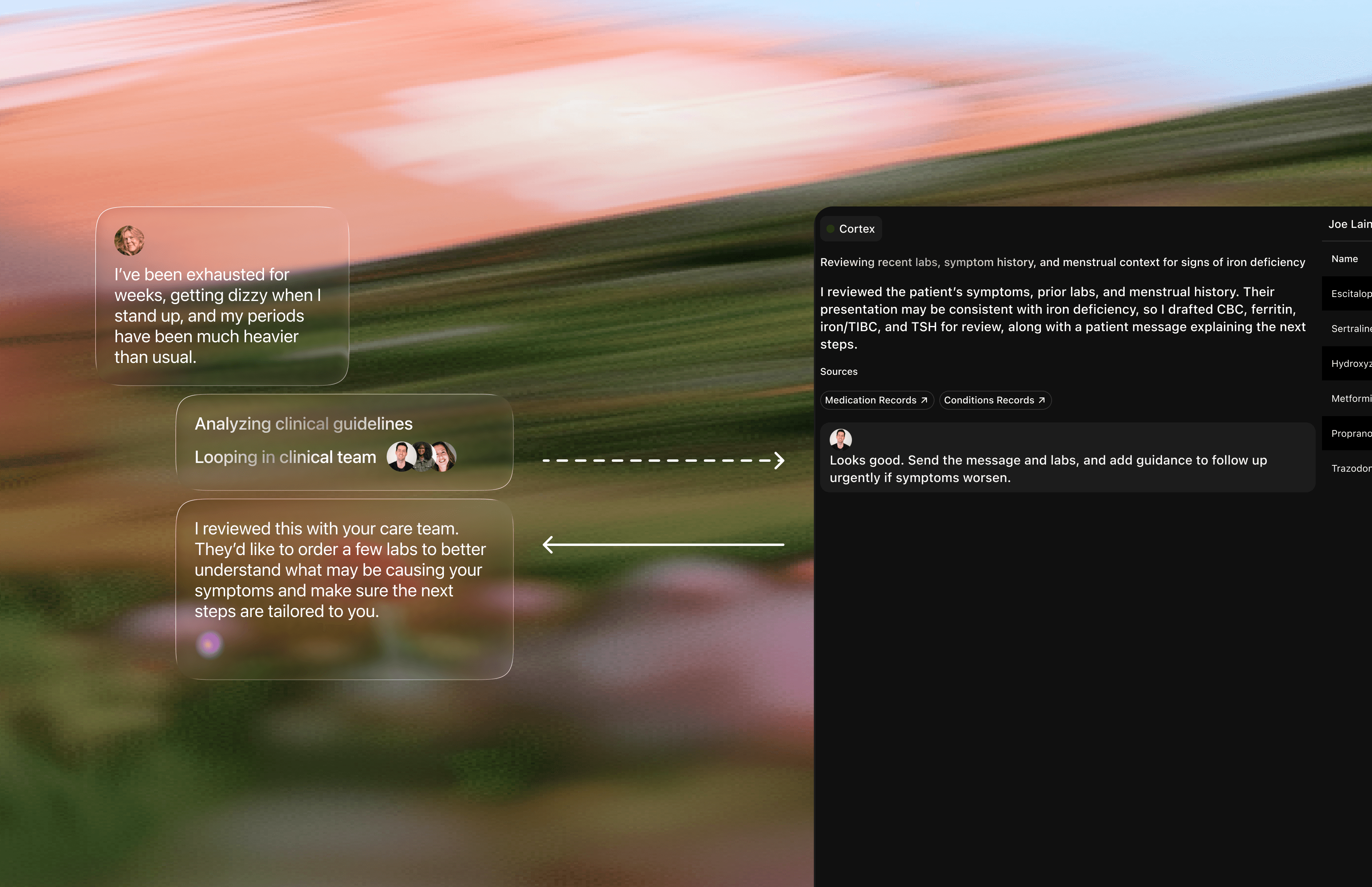
Lotus AI is an AI doctor powered by real physicians — licensed clinicians who review and oversee care. Accountability for treatment and prescribing rests with those clinicians, not the AI. AI has no legal standing to prescribe or bear malpractice liability. Lotus AI keeps a human in the loop; ChatGPT does not.
Conservative escalation and triage
The emerging consensus in clinical AI favors conservative escalation and mandatory human-in-the-loop workflows. Overtriage — sending someone to a higher level of care when they might not need it — is preferred over undertriage. Purpose-built medical AI is tuned to flag uncertainty and escalate rather than generate confident-sounding but potentially wrong answers. Lotus AI can triage symptoms and route users to urgent care or the ER when needed.
Your full health history in one place
Lotus AI unifies health records, wearable data, labs, medications, and insurance information so guidance is personalized — not generic. ChatGPT answers every question as if it is the first time it has met you. Lotus AI answers with your complete health story. That is a structural advantage no general chatbot can replicate.
Feature | ChatGPT | Lotus AI |
|---|---|---|
Built on clinical guidelines | No — general internet training | Yes — PubMed, JAMA, NEJM, USPSTF, and more |
Physician oversight | None | Licensed clinicians review care |
Can prescribe medications | No | Yes, non-controlled medications when clinically appropriate* |
Can order labs or imaging | No | Yes |
Accesses your health records | No | Yes — unified records, labs, medications, wearables |
Triage and escalation | No protocol | Routes to urgent care or ER when needed |
Cost | Free (no clinical accountability) | Free primary care |
Prescriptions and referrals issued when appropriate, reviewed by licensed physicians.
When to skip AI and seek emergency care
Some situations require emergency care immediately — no AI, no waiting. Call 911 or go to the ER for any of the following:
Chest pain or pressure, especially with sweating, arm or jaw radiation, or shortness of breath
Sudden facial drooping, arm weakness, or speech difficulty (signs of stroke — act within minutes)
Severe shortness of breath
Signs of anaphylaxis (a severe allergic reaction): throat swelling, hives, and difficulty breathing after an exposure
Vomiting blood, black or tarry stools, or bright red rectal bleeding with dizziness
Active suicidal ideation with a plan or intent — call 988 (Suicide and Crisis Lifeline) or 911
Pregnancy: heavy bleeding, severe headache with vision changes, or absent fetal movement
Infant under 3 months with any fever at or above 100.4°F (38°C)
Sepsis signs: high fever with confusion, rapid breathing, and low blood pressure
For anything that could be time-sensitive, the safe default is always emergency care. AI should support that decision, not replace it.
Lotus AI can help before and after an emergency — assessing whether symptoms warrant a 911 call, and after an ER visit, helping you understand discharge instructions, manage follow-up care, and keep your records unified. It is not the solution for emergencies, but it is the right starting point for triage and the right follow-through for recovery.
How Lotus AI can help you get reliable medical guidance
Lotus AI was built to close the gap between a general chatbot that sounds helpful and a real medical practice that can actually act on your behalf. It is a free primary care practice — an AI doctor powered by real physicians and the latest medical evidence, available 24/7.
What Lotus AI can do
Ask any health question, any time, in any language — available around the clock in over 50 languages
Get diagnosed — Lotus AI can diagnose conditions based on your symptoms, history, and records
Receive prescriptions when clinically appropriate — including antibiotics for strep throat, SSRIs for depression and anxiety, inhalers for asthma, oral contraceptives after safety screening, and statins for high cholesterol
Order labs and imaging — blood work, panels, X-ray and MRI referrals
Get referred to the right specialist — when something exceeds primary care scope
Triage urgent symptoms — routes to urgent care or the ER when needed
Unified health records — aggregates your records, wearable data, and insurance information in one place
What Lotus AI cannot do
Being transparent about limits is part of what makes a medical tool trustworthy:
Cannot prescribe controlled substances — medications like Adderall, Xanax, or opioids require an in-person visit by law
Cannot perform physical exams or procedures — Lotus AI is virtual-only
Cannot manage acute emergencies — it is a triage and primary care tool, not an ER
Cannot guarantee a prescription — every prescribing decision is made by a licensed clinician
Does not cover the cost of medication — Lotus AI provides free care, not free drugs
Does not connect you with a live doctor in real time — it is an AI doctor backed by real physicians, not a live phone line
Even where Lotus AI has hard limits, it can still help — by assessing whether your symptoms need in-person care, preparing your unified records so any in-person visit is more effective, and coordinating follow-up after a specialist or ER visit.
Why Lotus AI is free
Lotus AI removed waste, automated routine work, and unified data so physicians can be more productive and the cost of care comes down. There are no hidden fees, no surprise bills, and no data sales. Your data belongs to you, is encrypted, and is used only for your care.
This article is for educational purposes only and does not provide medical advice. Always consult a licensed healthcare professional for diagnosis or treatment decisions. If you think you may be having a medical emergency, call 911 immediately.
Sources
ChatGPT’s aptitude for medical education: comparison with third‑year medical students in a pulmonology exam — JMIR Medical Education, 2024
Comparative analysis of ChatGPT and Bard in answering pathology examination questions requiring image interpretation — American Journal of Clinical Pathology, 2024
Use of GPT‑4 to Diagnose Complex Clinical Cases — NEJM AI, 2023
ChatGPT shows ‘impressive’ accuracy in clinical decision making — Mass General Brigham, 2023
ChatGPT with GPT‑4 outperforms emergency department physicians in diagnostic accuracy: retrospective analysis — JMIR, 2024
Large language models for clinical artificial intelligence in healthcare: a systematic review — Discover Artificial Intelligence, 2025
A framework to assess clinical safety and hallucination rates of LLMs for medical text summarisation — npj Digital Medicine, 2025
A framework for clinical hallucination risk in complex clinical cases — JMIR Medical Informatics, 2025
A comprehensive survey on the trustworthiness of large language models in healthcare — arXiv, 2025
Multi‑model assurance analysis showing large language models are highly vulnerable to adversarial hallucination attacks during clinical decision support — PubMed Central, 2025