AI Healthcare
Primary Care AI
Lotus Health AI
Clinical Decision Support
Healthcare Innovation
AI healthcare is getting better fast — but the real question isn't whether it will replace your doctor, it's which parts of care it can handle safely and where you still need a human in the room.
What "AI replacing doctors" actually means
The short answer is no — AI is not replacing doctors. It is replacing specific tasks that doctors have always spent too much time on. The evidence points clearly to task replacement, not doctor replacement. AI excels at pattern recognition, structured triage, and routine documentation. Clinicians remain essential for physical exams, complex diagnostic reasoning, shared decision-making, and high-stakes prescribing.
The distinction matters because it changes how you should think about AI healthcare tools. They are not a substitute for your physician. They are a way to get faster, more consistent support for the parts of care that do not require someone to look you in the eye, press on your abdomen, or weigh competing diagnoses from a decade of clinical experience.
Why AI healthcare is expanding now
Three forces are driving AI adoption in medicine [1] — none of which are going away.
Physician shortages and burnout
The gap between patient demand and available primary care physicians is growing. Appointment wait times stretch to weeks or months in many parts of the country, and physician burnout remains a persistent problem that pushes experienced clinicians out of practice. AI helps reduce workload in non-critical areas so the clinicians who remain can focus on the patients who need them most.
Administrative overload on clinicians
For every hour a doctor spends with a patient, they spend close to two hours [2] on work that does not require a medical degree. AI can absorb much of that burden:
Documentation and charting: AI scribes listen to visits and draft clinical notes automatically
Billing and coding: Automated code suggestions generated from visit summaries
Inbox management: Routing simple patient messages and refill requests without physician involvement
When that friction disappears, doctors have more time for the work only they can do.
Patient demand for immediate answers
Patients increasingly expect same-day guidance, clarity before appointments, and access outside business hours. An AI doctor available around the clock — in any language, without a waiting room — can fill the gap between scheduled visits, though it should always escalate urgent or complex cases to in-person care. That is where tools like Lotus AI fit: as a first point of contact that is always available, not a replacement for the clinician you see twice a year [3].
What an AI doctor can safely help with today
AI health tools are most reliable when the task is bounded, structured, and evidence-based. That covers more ground than most people realize.
Symptom triage and care routing
AI can gather structured symptom information, screen for red flags, and route you to the right level of care — whether that is self-care at home, an urgent care visit, or the emergency room. Clinical guidelines are clear that triage tools should err on the side of caution, and well-designed AI systems follow that principle. Think of AI triage as a starting point that takes your symptoms seriously, not a tool that tells you everything is fine.
Evidence review and patient education
AI can translate medical terminology into plain language, explain what your lab values mean, and help you walk into your next appointment with better questions. A useful way to think about it: AI is a well-read research assistant, not a second doctor. Specific ways it helps:
Plain-language explanations: Turning lab results and clinical terms into language you can actually use
Visit preparation: Generating relevant questions to bring to your appointment
Guideline-based context: Surfacing what current evidence says about a symptom or condition
Refills, labs, and noncontrolled prescriptions
For clinically stable chronic conditions — where symptoms are controlled, medications are unchanged, and no new concerns have emerged — telehealth platforms backed by licensed clinicians can handle refills without a new in-person exam. Blood pressure medications can be managed with home monitoring. Thyroid medications can be refilled with periodic lab rechecks. Diabetes medications can continue with routine HbA1c monitoring.
The key word is "clinically." Every prescription is a clinical decision made by a licensed physician, supported by AI tools that surface relevant history and guidelines. Prescriptions and referrals are issued when appropriate, reviewed by licensed physicians.
What AI cannot replace
Some clinical findings simply cannot be obtained remotely. When the critical diagnostic signal is tactile, positional, or tissue-based, remote assessment introduces unacceptable uncertainty.
Physical exams and procedures
Several situations reliably require hands-on evaluation:
Acute abdominal pain: Rebound tenderness, guarding, and rigidity are tactile findings — clinical prediction rules alone are not sufficient to rule out appendicitis or perforation
Wound evaluation: Depth, necrosis, foreign body presence, and tissue viability require direct inspection and probing
Suspicious skin lesions: Biopsy is required for definitive diagnosis of suspected melanoma — a photo cannot substitute
Joint instability: Stress tests and stability assessments require physical loading that cannot be replicated remotely
Pelvic exams and Pap tests: Cervical visualization and bimanual assessment cannot be performed virtually, and missing findings risks delayed diagnosis
Emergency and red-flag symptoms
For any of the following, call 911 or go to the ER immediately — no AI tool first:
Chest pressure, tightness, or pain — especially with sweating, arm or jaw radiation, or nausea (possible heart attack; every minute of delay increases heart muscle loss)
Sudden face drooping, arm weakness, or slurred speech — stroke treatment is time-critical and only available in an emergency department
A sudden "worst headache of your life" — particularly with neck stiffness or onset during exertion, a validated warning sign for a serious bleed in the brain
Suspected anaphylaxis — throat swelling, hives with breathing difficulty after an exposure; epinephrine is the essential treatment and EMS should always be activated
Severe shortness of breath — oxygen and airway management cannot be provided remotely
Abrupt onset, symptoms triggered by exertion, fainting, or fever all raise the urgency across every category. Older adults and pregnant individuals may present atypically and should have a lower threshold for going to the ER.
Complex cases with multiple conditions
Patients managing several chronic conditions at once — with overlapping medications, competing symptoms, and unclear presentations — need a clinician who can weigh all of it together. AI works best supporting diagnosis and management, not replacing the judgment that comes from years of clinical training. When blood pressure or blood sugar values are persistently out of range, when new symptoms appear, or when organ-function labs are overdue, in-person evaluation is the right call.
How Lotus AI supports your care
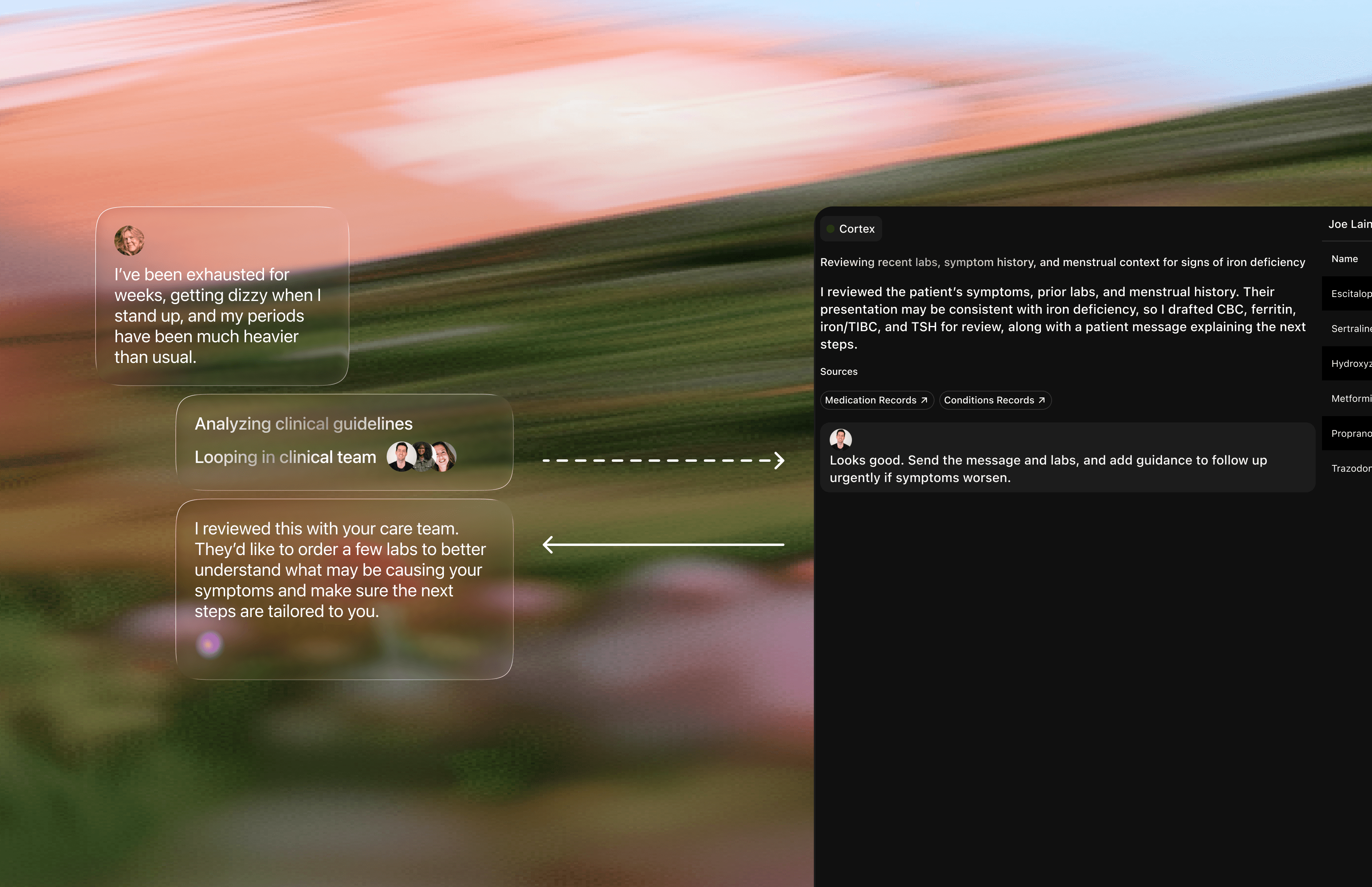
Lotus AI is a free primary care practice — an AI doctor powered by real physicians and the latest medical evidence. It is built for the space between emergencies and scheduled appointments: the health questions that come up at midnight, the refill you need before your next visit, the lab result you cannot interpret.
Here is what Lotus AI can do:
Ask any health question, any time, in any language: Available in more than 50 languages [4], with no insurance required and no cost to the patient
Support diagnosis and prescribing when appropriate: Lotus AI can help diagnose conditions based on your symptoms, history, and records. Licensed clinicians can prescribe noncontrolled medications — including antibiotics for uncomplicated infections, blood pressure and cholesterol medications, SSRIs for depression and anxiety, oral contraceptives, inhalers, and dermatologic treatments — supported by AI tools that surface relevant clinical guidelines and patient history. Prescriptions and referrals are issued when appropriate, reviewed by licensed physicians.
Coordinate labs, imaging, and specialist referrals: When something exceeds primary care scope, Lotus AI can help coordinate referrals to the right specialist
Unify your health records: Aggregates your records, labs, medications, wearable data, and insurance information into one place so guidance reflects your full health story — not fragments from a single visit
Triage and escalation: Lotus AI assesses symptoms and routes you to urgent care or the ER when needed — it knows when to step back
What makes Lotus AI different from a general AI chatbot is accountability. ChatGPT's own terms say not to rely on it for medical decisions. Lotus AI is a real medical practice with licensed clinicians who can diagnose, prescribe, and refer. Guidance is built on peer-reviewed studies and all major clinical guidelines. Your data is encrypted, used only for your care, and never sold.
Try Lotus AI Free
Learn How It Works
Lotus AI is a free primary care practice. Prescriptions and referrals issued when appropriate, reviewed by licensed physicians. Not a replacement for emergency care.
The honest answer to the question
AI healthcare will not replace in-person doctors. It will — and already does — replace the tasks that were never the best use of a physician's time in the first place: the intake forms, the routine refills, the 2 a.m. symptom questions, the administrative backlog that kept doctors from their patients.
What remains irreplaceable is the clinician who can press on your abdomen, read the room, and make a judgment call when the data does not tell the whole story. The future of care is not AI versus doctors. It is AI handling the work it does well, so doctors can focus on the work only they can do — and patients get both.
This article is for educational purposes only and does not provide medical advice, diagnosis, or treatment. Always consult a licensed healthcare professional for diagnosis or treatment decisions. If you may be experiencing a medical emergency, call 911 or your local emergency number now.
Sources
Adoption of artificial intelligence in healthcare: survey of health system priorities, successes, and challenges — Journal of the American Medical Informatics Association (JAMIA), 2024
For every hour of direct patient care, physicians currently spend 2 hours on the Electronic Health Record (EHR) system — U.S. Department of Health and Human Services, 2026
FastStats – Physician office visits — National Center for Health Statistics (CDC), updated through 2024
Best AI Doctor Alternative to ChatGPT 2026 — Lotus Health AI, 2026