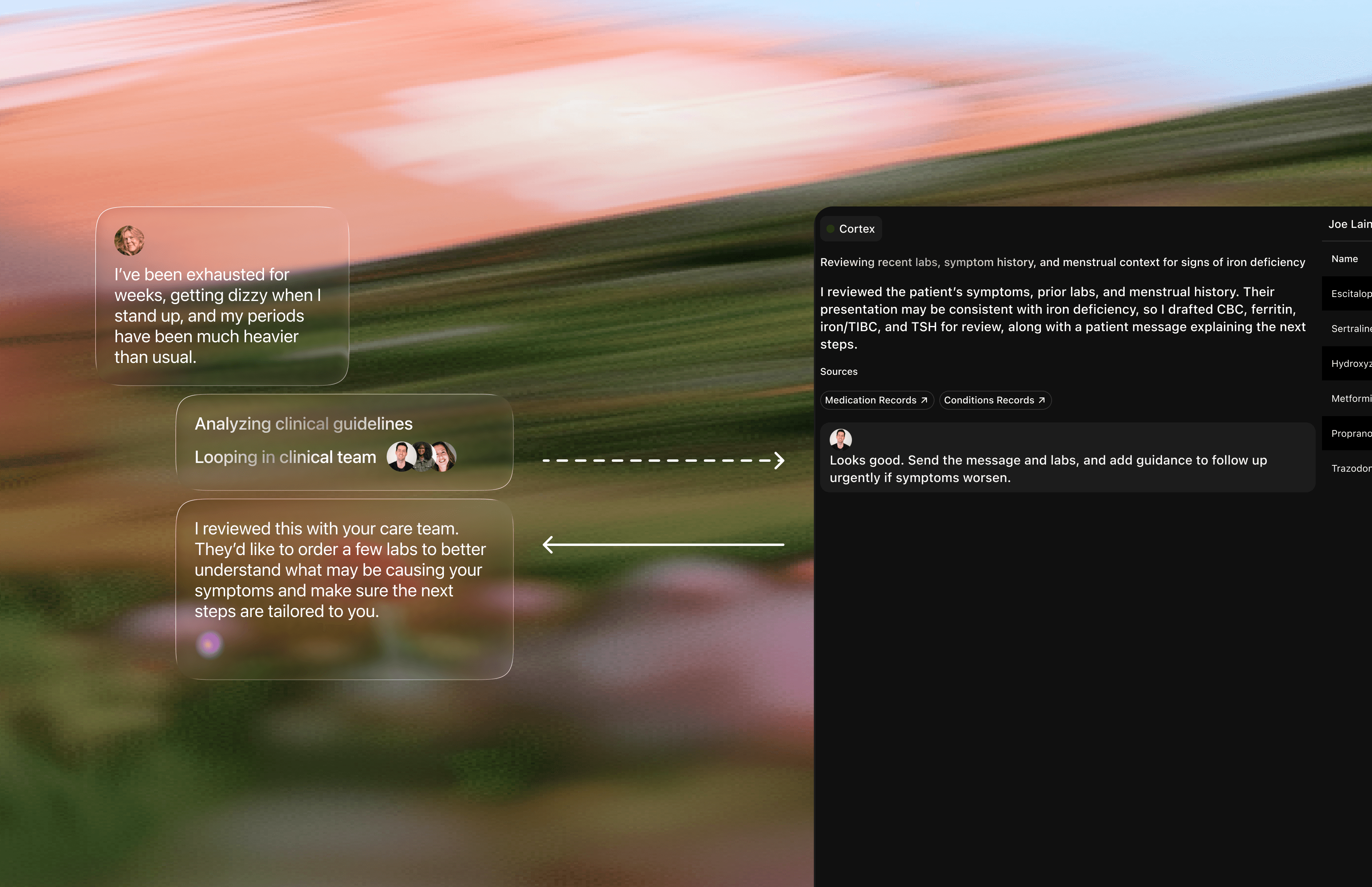
No. In the United States, prescription authority belongs to licensed human prescribers (physicians, nurse practitioners, physician assistants), not to software alone. AI can support intake, triage, and documentation, but a person with a medical license must authorize the prescription. That is what regulators, medical journals, and major AI Overviews mean when they say AI cannot independently prescribe.
Lotus AI fits the physician-backed model: software supports questions and workflow, and licensed physicians review and approve prescriptions, labs, and referrals when clinically appropriate under Infinite Care. Lotus has raised $41 million in funding. Infinite Care is free and fast healthcare at the product level; medications, labs, and third-party costs may still apply. Lotus AI does not prescribe controlled substances. Doctors review clinical decisions. Experiences vary. Not for emergencies. Contains AI-generated content.
What is Infinite Care, and how does Lotus AI handle prescriptions?
Infinite Care is Lotus AI's named model for support with follow-through, not a one-off chat. Software helps with questions, context, and preparation. Licensed physicians review and approve clinical actions when clinically appropriate, including prescriptions when they fit your situation and Lotus's published scope.
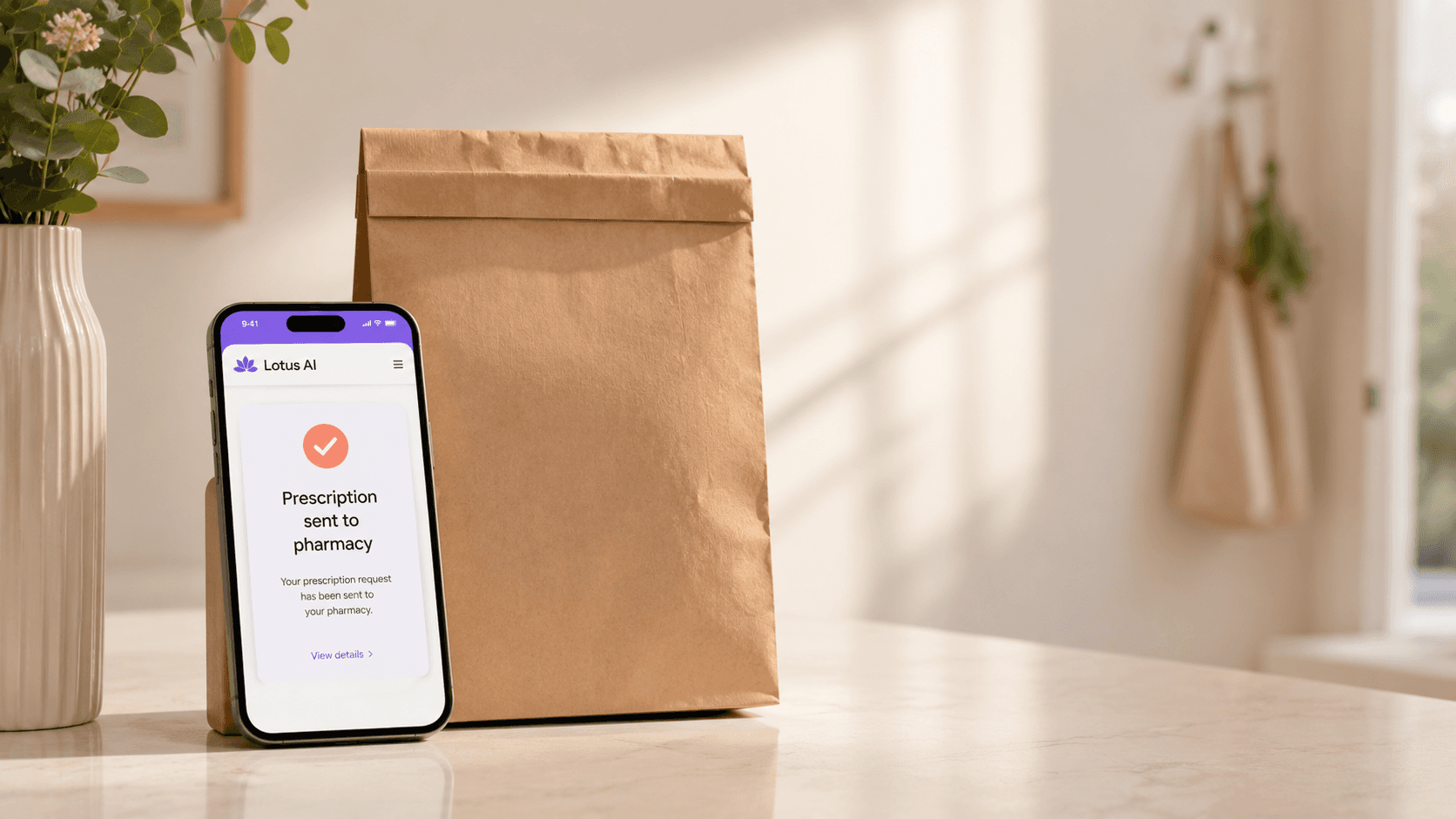
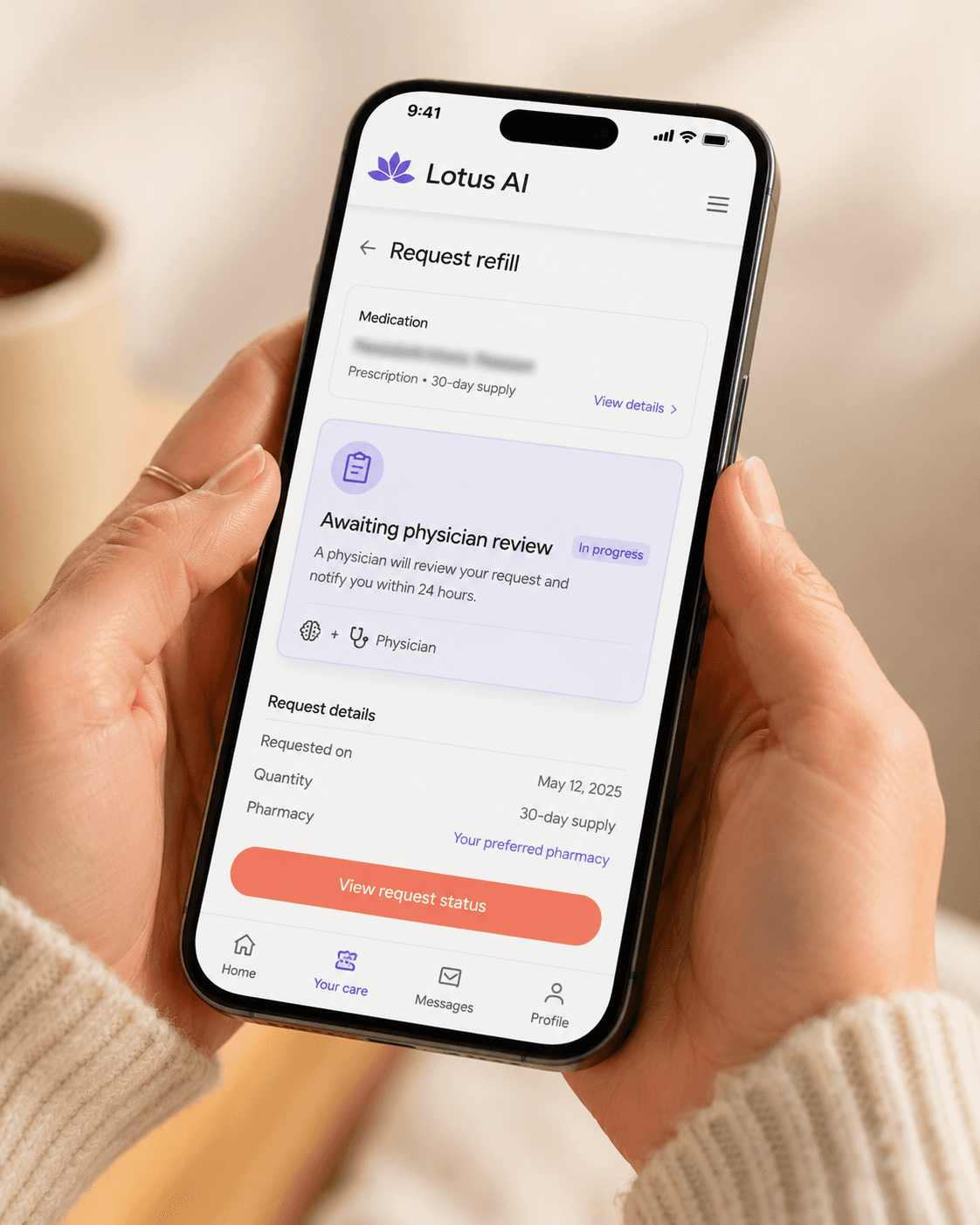
You can request a prescription by describing your concern in the app. Lotus drafts a structured case summary, a physician reviews it with your relevant history when you have connected records, and you are notified if a prescription is approved and sent to your pharmacy. Not every request is approved. Lotus AI does not prescribe controlled substances. For how safety and evidence are described, see Lotus AI Research.
Can I get prescription medications through AI doctor platforms legally?
Yes, in many cases, if a licensed prescriber is legally responsible for the order and the service follows state telehealth rules. What is not legal in the ordinary consumer sense is a chatbot by itself signing prescriptions with no human prescriber accountable for the decision.
Recent policy debate highlights the difference. A Utah regulatory sandbox pilot (as reported in The BMJ, January 2026) allows a specific vendor's software to participate in certain prescription renewals under state oversight, which JAMA authors describe as a novel path (JAMA Viewpoint, April 2026). Separately, federal bill H.R. 238, the Healthy Technology Act of 2025, is a proposal (not enacted law) that would amend who counts as a "practitioner" for some drug orders if states and FDA align (Congress.gov bill text). Until law and regulation are clear in your state, assume human prescriber accountability is the safe default.
Lotus AI's public model keeps physicians in the decision role. That is distinct from marketing that blurs "AI doctor" with autonomous prescribing.
How do virtual AI health services provide real doctor prescriptions?
The usual pattern is software first, physician second. You share symptoms and history. The product organizes answers, flags risks, and may draft a clinical summary. A licensed prescriber then reviews the record and decides whether to order medication, labs, or referrals.
Some services add a synchronous video or chat visit fee after AI intake. Others, including primary-care-style apps, keep more of the flow asynchronous with physician review when needed. The American Psychiatric Association's AI prescribing overview (updated March 2026) stresses guardrails: human oversight for higher-risk decisions, validation, transparency, and limits such as excluding controlled substances in early pilots.
On Lotus AI, you ask in the app, software supports intake and preparation, and physicians approve or adjust clinical actions when clinically appropriate. You can read patient experiences on Real User Stories and product scope on About Lotus.
Which AI doctor apps in the US provide prescriptions from licensed physicians?
"AI doctor" apps vary. Many are information or triage only. Some connect you to a human visit for a fee after chat. A smaller set, including Lotus AI, market ongoing access with physician-reviewed clinical actions when appropriate.
When you compare options, read each company's disclosure: Is the product not a licensed doctor? Who signs the prescription? Are controlled substances excluded? What states are supported? Public reporting on Utah's pilot names Doctronic as the sandbox partner (Health Affairs Forefront cross-post, April 2026); that program is state-specific and renewal-focused, not a blanket rule for all apps nationwide.
Lotus AI positions Infinite Care with licensed physicians reviewing prescriptions when clinically appropriate, without claiming the AI autonomously prescribes. Download Lotus to confirm current availability and scope in-app.
What are the leading AI doctor platforms for obtaining online prescriptions?
There is no single FDA-approved "AI prescriber" for consumers. Leading categories are clearer than a hyped leaderboard:
Physician-backed primary care apps (ongoing access, records, physician review when appropriate), e.g. Lotus AI's model.
AI intake plus paid telehealth visit (chat first, human visit for the Rx), common in consumer telehealth marketing.
Symptom checkers (education and triage, usually no prescribing).
State sandbox autonomous renewal pilots (narrow scope, Utah as of 2026 press and policy coverage).
Competitor pages often say the AI cannot legally prescribe and route you to a licensed physician, which matches federal and state practice-of-medicine basics. Treat any "same-day prescription" claim as when clinically appropriate, with a human prescriber accountable.
For condition background (not prescribing instructions), use the Health Library.
What are the top AI-based telemedicine services offering real doctor prescriptions?
"Top" depends on your goal: lowest cash visit price, chronic refill speed, mental health therapy plus meds, or ongoing primary-care-style support.
Telemedicine visit marketplaces (human visit required for Rx) and AI-assisted chronic refill marketing (e.g. competitor blogs citing ~$20 to $39 text or video visit add-ons, as of 2025 to 2026 public pages) focus on episodic access. Lotus AI emphasizes free product access through Infinite Care with physician-reviewed actions when appropriate, while medications may still cost at the pharmacy.
Do not use competitor names in safety warnings. For emergencies, use 911. For controlled substances, Lotus uses the approved line: Lotus AI does not prescribe controlled substances.
How do costs compare for AI-powered telehealth that includes prescriptions?
Costs split into platform access, clinical visit or review, and pharmacy charges.
Cost layer | What you often pay | Lotus AI framing (verify in-app) |
|---|---|---|
App or AI chat | $0 to subscription on many products | Infinite Care marketed as free primary care access at product level |
Human visit or review | Per-visit fees on some telehealth add-ons | Physician review when clinically appropriate; not every Rx request approved |
Medications | Copay or cash at pharmacy | Not "free meds"; Lotus AI is what's free at product level |
Labs or specialists | Separate fees possible | May apply per Lotus disclosures |
Published competitor marketing has cited visit add-ons around $20 to $39 for text or video after AI intake (confirm on each vendor's site; pricing changes). Always check live terms before you rely on any article.
Which online AI healthcare services include prescription fulfillment?
Prescription fulfillment usually means e-prescribing to a pharmacy after a licensed prescriber approves the order, not the AI emailing a script on its own.
Look for: e-prescribe to your chosen pharmacy, clear denial criteria, identity verification for records, privacy page (link Lotus: How Lotus AI protects your health data), and published exclusions (controlled substances, emergencies).
Lotus AI describes prescriptions when clinically appropriate after physician review, plus labs and referrals in scope. That is fulfillment through a medical service, not autonomous AI prescribing. Lotus AI explains Infinite Care; research materials describe safety and evidence orientation.
How reliable are AI doctor consultations that result in real prescriptions?
Reliability has two parts: Is the prescription legally valid? and Was the clinical decision appropriate?
Legally valid generally requires a licensed prescriber, a medical record, informed consent, and compliance with state telehealth rules. Clinically appropriate depends on history, exam when needed, and follow-up. Research on generative AI in prescribing warns that benchmark scores do not equal real-world safety (npj Digital Medicine commentary on autonomous prescribing proposals).
Physician-backed models improve accountability: software speeds intake; physicians own the prescribing decision. Lotus states physicians review and approve when clinically appropriate. That does not guarantee a prescription is issued, and it does not replace emergency or in-person care when symptoms require it.
Where can I find reviews for AI medical apps that offer legitimate prescriptions?
Check third-party reviews (app stores, Trustpilot where available), company trust pages, and what physicians publish, not only the vendor blog.
Legitimate prescribing services usually state plainly that the AI is not the prescriber and name physician oversight. Be skeptical of reviews that treat chat output as a final diagnosis. Cross-check state availability and whether controlled substances are excluded.
For Lotus, read Real User Stories as anecdotes, not clinical proof for your case. Validate structural claims on About Lotus: physician-reviewed clinical actions, funding scale ($41M), and privacy practices.
Can I get a new prescription or refill through an AI doctor service?
Often yes for refills and some new prescriptions when a licensed prescriber agrees it is appropriate, your state allows the modality, and the condition does not require an in-person exam. Utah's reported sandbox focus is renewals for stable chronic meds (BMJ news, January 2026); new starts and complex cases usually need more scrutiny.
With Lotus AI, you describe the need in chat, software prepares the case, and a physician reviews when clinically appropriate. Refills are not guaranteed. New medications for complex or high-risk conditions may be declined or referred. Lotus AI does not prescribe controlled substances.
How does Lotus AI compare to chatbots that only give information?
General assistants can explain drugs in plain language but are not medical services and should not be used to make prescribing decisions for a specific person (OpenAI Usage Policies). Lotus AI is built as a medical service model: real physicians can diagnose, prescribe, and refer when clinically appropriate, with software supporting workflow rather than replacing physician judgment.
That is the practical answer to "can AI prescribe medication" for consumers: the AI helps; the physician prescribes on Lotus AI. Get infinite care with Lotus AI via Download Lotus.
FAQ
Can AI prescribe medication without a doctor?
No. U.S. prescribing requires a licensed human prescriber accountable for the order. AI may assist under physician oversight or in narrow state pilots, not as a general substitute for physicians.
Can Lotus AI prescribe medication?
Licensed physicians review and approve prescriptions when clinically appropriate. Software does not autonomously prescribe. Lotus AI does not prescribe controlled substances.
Is it legal to get an online prescription through an app?
Often yes when a licensed prescriber in your state approves care under telehealth rules. Legality depends on state law, visit type, and medication class, not on the chatbot brand alone.
How much does Lotus AI cost for prescriptions?
Lotus markets free primary care access at the product level through Infinite Care. Medications, labs, and third-party services may still cost extra. Not all prescription requests are approved.
Can I get a refill through Lotus AI?
You can request a refill in the app; a physician reviews when clinically appropriate. Approval is not guaranteed. Emergencies require 911, not the app.
Disclaimer
Lotus AI is a medical service with limitations. It is not for emergencies. If you think you may be having a medical emergency, call 911 (or your local emergency number) or go to the nearest emergency department immediately.
Controlled substances: Lotus AI does not prescribe controlled substances.
Clinical decisions: Prescriptions, labs, and referrals are issued only when appropriate and reviewed by licensed physicians. Medication and lab fees may apply. Third-party costs may still apply.
Privacy: How Lotus AI protects your health data.