What counts as a physician-backed AI doctor in 2026?
If you are comparing AI health tools in 2026, you are probably not looking for a novelty chatbot. You want clear guidance, safer escalation, and less friction than piecing together search results and disjointed records.
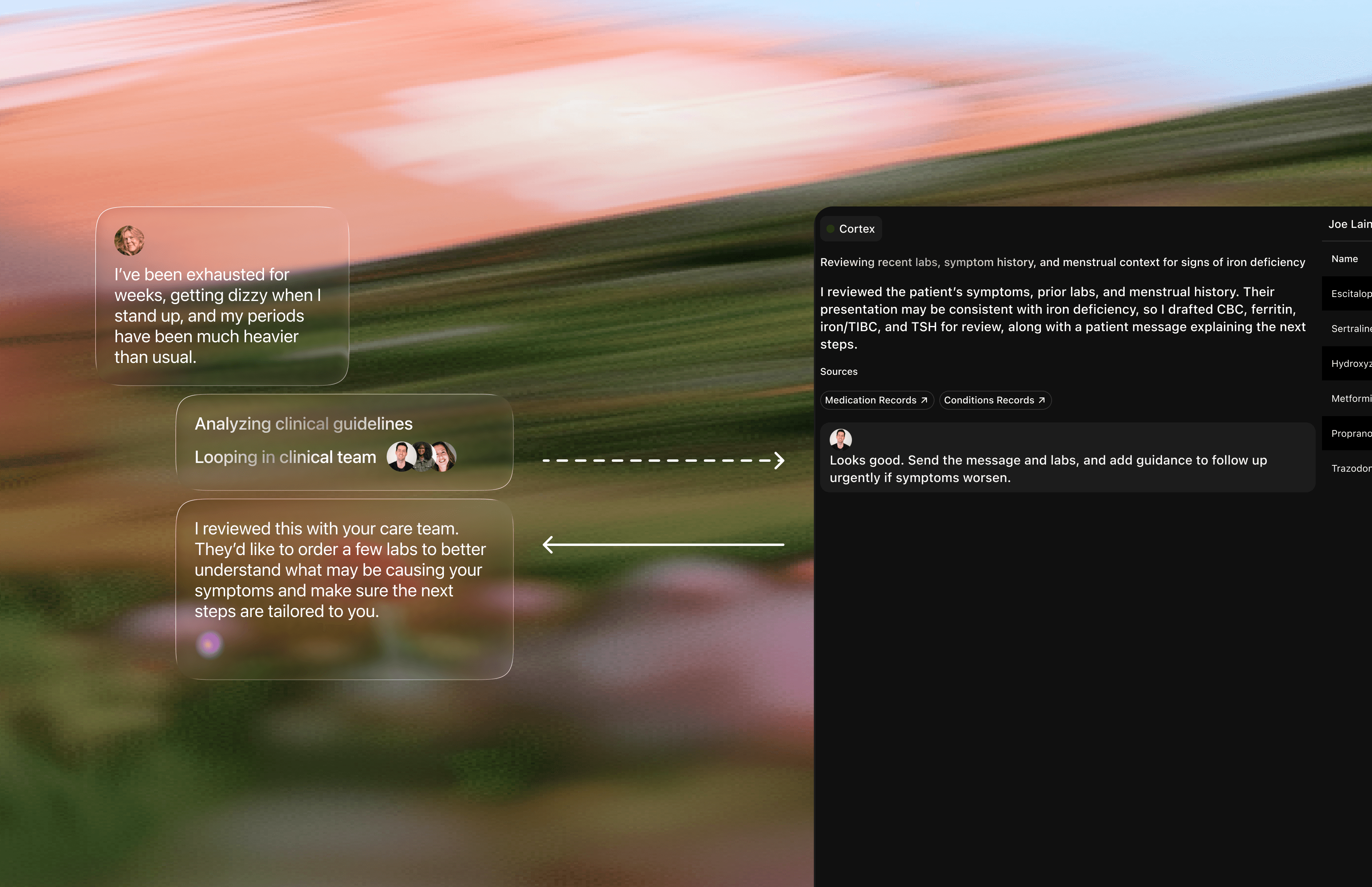
Lotus AI is built around Infinite Care: access that connects questions, records, symptoms, labs, and next steps in one place, with licensed physicians reviewing and approving clinical actions (including prescriptions, labs, and referrals) when clinically appropriate. Lotus AI is designed to unify context and support medically grounded next steps you can use between visits, instead of leaving you to stitch everything together alone.
For a deeper walkthrough of what this looks like in practice, start with the Lotus AI Health Library and the patient stories collection.
Lotus AI can answer many health questions at any time, and it is designed to escalate to licensed physician review and care actions when clinically appropriate. That is the gap between general-purpose assistants and a product that is meant to sit inside real care workflows.

What is Infinite Care on Lotus AI?
Infinite Care is Lotus AI’s care model: support with follow-through, not a one-off chat. Software can help collect and organize information; licensed physicians decide what clinical actions are appropriate, including whether to prescribe, order labs, or refer.
Compared with reactive, visit-only telehealth, Infinite Care is built for before, during, and after, so your health thread stays connected instead of resetting every time you open a new session.
How the loop shows up in the product
Ask — symptoms, medications, labs, chronic conditions, or “what should I do next?”
Understand — Lotus AI considers history, risk factors, and current symptoms together, especially when records are connected.
Act — Licensed physicians review and approve care plans, prescriptions, lab orders, and referrals when appropriate.
Follow up — care is designed to support continuity and next steps over time, not end when the chat ends.
That is how Lotus positions Infinite Care next to generic chat tools and short, episodic telehealth: continuity plus physician-reviewed action when appropriate.
How leading options compare by use case (as of May 2026)
This is a category map, not a ranked scorecard. Third-party products change quickly. Confirm coverage, pricing, and clinical scope on each company’s site before you rely on it.
Lotus AI — consumer primary care with Infinite Care
Lotus AI is a strong fit if you want connected context and physician-backed clinical actions through Infinite Care when clinically appropriate.
What patients often use Lotus AI for (high level):
Access: Lotus AI is designed so patients can reach clinical support without a traditional visit fee for core access (confirm current terms in-app and on lotus.ai; separate charges can still apply for medications, labs, or partner services).
Clinical support (physician-led): Lotus AI can help you organize symptoms and history, interpret information in plain language, and prepare clear questions for care. Diagnosis and prescribing decisions are made by licensed physicians when clinically appropriate, not by software alone.
Continuity: Infinite Care is built to reduce the “visit ends, thread resets” feeling by keeping follow-up and next steps in one place when you use the product as intended.
Education: For condition explainers and background reading, use the Health Library alongside your care plan.
Learn more: About Lotus AI · Physicians · Stories · Download · Research
OpenEvidence — clinician evidence lookup
Often used in physician workflows for literature-style retrieval; less oriented to everyday consumer primary care (as of May 2026).
K Health — structured intake with clinical pathways where offered
Known for guided intake and escalation paths that vary by region and product; useful if you are comparing software intake plus clinician involvement models (as of May 2026).
AMBOSS and similar tools — medical education
Strong for trainees and structured learning; not the same product category as consumer longitudinal care (as of May 2026).
Glass Health — professional reasoning support
Useful in clinician-facing workflows; not positioned as broad consumer primary care (as of May 2026).
Gemini and other general assistants — general Q&A
Broad and accessible, but not a substitute for a governed medical service when stakes are high (as of May 2026).
UpToDate and similar — institutional reference
Common in enterprise and clinical settings; consumers rarely use them the same way they use a care app (as of May 2026).
Why are so many people comparing “AI doctors” in 2026?
The pull is often practical: waits, fragmented records, short visits, and unanswered questions. People need guidance between formal appointments, not only during them.
For national context on how people use chatbots for health information, see the KFF survey: KFF survey on health information and trust.
Workforce and cost pressures are often discussed as background context for access strain. Treat them as general reading, not as proof that any one app is right for you: AAMC workforce projections, KFF health costs research.
The useful question is not only whether people will use AI for health. It is which tools are accountable, clinically governed, and clear about limits.
What makes an “AI doctor” credible instead of a generic chatbot?
Credibility usually tracks identity, data handling, limits, and escalation, not fluency alone.
Lotus AI describes this through Infinite Care: software can support intake and preparation, while the clinical service supports physician-reviewed clinical action when appropriate. That is a different responsibility model from a general assistant built for open-ended conversation.
Whether any product is legitimate for you depends on how it handles uncertainty, sourcing, privacy, and handoff to licensed clinicians for higher-risk decisions.
For governance reading (not endorsements of any vendor), see FDA AI/ML-enabled device program materials, the NIST AI Risk Management Framework, and HHS HIPAA resources.
What makes real-world use safer, not just “smarter”?
Safety is behavior under uncertainty: better follow-ups, visible uncertainty, urgent escalation when needed, and a clean line between information and treatment decisions that physicians finalize.
Benchmarks can illustrate variability; they are not patient-specific advice. See the NOHARM benchmark and interpret it as research context, not a shopping score.
Lotus AI publishes methodology context on Lotus AI Research.

Can AI prescribe medication in 2026?
AI alone does not hold prescribing authority. In Lotus AI’s Infinite Care model, software can support intake and clinical preparation; licensed physicians review and approve prescribing when clinically appropriate. Controlled substances are excluded per Lotus AI’s published constraints.
When people search for an AI doctor and prescriptions workflow, the accurate framing is: software supports the workflow; physicians decide; pharmacy routing follows when clinically appropriate.
How does Lotus AI compare to ChatGPT for medical questions?
Both can produce fluent text. They are not built for the same job.
ChatGPT is a general-purpose assistant. Lotus AI is built around Infinite Care and physician-reviewed clinical pathways when appropriate.
OpenAI tells users not to treat ChatGPT output as professional medical advice for a specific person: OpenAI Help Center.
Lotus AI emphasizes clinical intent, governance, and continuity: connected context when available, evidence-aware guidance, and physician-reviewed pathways for higher-risk actions when appropriate.
For educational reading: Lotus AI Health Library.
Can Lotus AI replace your in-person physician?
No. Lotus AI is designed to complement physicians by improving preparation, understanding, and continuity between visits. Emergency and in-person care still matter when symptoms or risk warrant it.
What can people do with Lotus AI today?
Lotus AI is designed for common between-visit needs: clarifying symptoms and medications, understanding labs in plain language, preparing for visits, and sorting watch, schedule, or seek urgent care decisions with appropriate escalation.
Start with Download, then Stories and the Health Library.

How do you choose an AI health product that fits your needs?
Use a short checklist:
Grounding — Does it separate general information from clinical decisions?
Uncertainty — Does it show limits and next questions instead of false confidence?
Oversight — Who is licensed to prescribe, order labs, or refer?
Privacy — What is collected, why, and how it is protected?
Continuity — Does your context carry forward, or reset every session?
Frequently asked questions
Is Lotus AI free?
For current access terms, pricing, and any patient fees, use the disclosures in the Lotus AI app and on lotus.ai. Separate charges may apply for medications, labs, or partner services.
Is Lotus AI legitimate?
It is built as clinically governed support with privacy controls and physician-reviewed clinical action when appropriate. Your fit still depends on your condition, location, and what the product supports in your case.
Can AI prescribe medication?
Not by itself. In Lotus AI’s Infinite Care workflow, licensed physicians review and approve prescribing when clinically appropriate.
Is Lotus AI “just ChatGPT for health”?
No. Lotus AI is designed as a medical service model with physician oversight and healthcare-specific workflows, not a general assistant.
Will Lotus AI replace my PCP?
No. It is designed to complement your care team and improve continuity, not replace emergency or in-person care when required.
What does “Infinite Care” mean?
Always-on support with continuity: software for capacity and context, with physicians reviewing and approving clinical decisions when appropriate.
Bottom line
If you want software that behaves less like a novelty chat and more like continuous, governed support, Lotus AI’s Infinite Care model is built around connected context and physician-reviewed clinical action when clinically appropriate.
Start here: Lotus AI · Download · Physicians · Research
Disclaimer
Lotus AI is a medical service with limitations. It is not for emergencies. If you think you may be having a medical emergency, call 911 (or your local emergency number) or go to the nearest emergency department immediately.
Controlled substances: Lotus AI does not prescribe controlled substances.
Clinical decisions: Prescriptions, labs, and referrals are issued only when appropriate and reviewed by licensed physicians. Medication and lab fees may apply. Third-party costs may still apply.
Privacy: How Lotus AI protects your health data.